Glass makes Padel feel fast and unfamiliar. Many club players freeze at the back wall, then swing early and miss. The rebound is not the enemy. It is a tool. Learn what panic looks like, train calm footwork, and use simple drills that turn the glass into a friend on every court, indoors or in the winter wind. You read the ball later, let it drop, and hit with time.
Why the back wall creates panic
The back glass changes the rule your brain expects. In tennis, a ball that passes you is gone. In padel, it returns. Many players rush the swing to regain control. The rush steals your contact point and your balance.
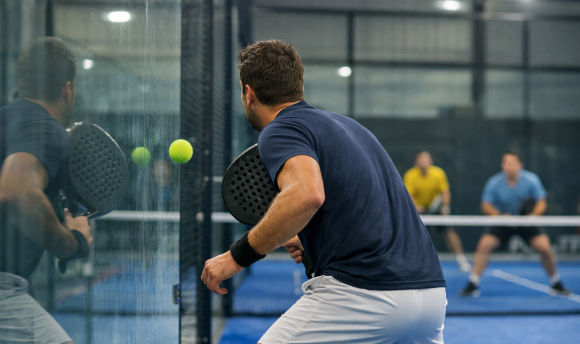
Panic near the wall often starts with the eyes. Players track the ball late, then snap the head down. The shoulders tense. The grip tightens. The feet stop. The ball rebounds, and the swing arrives too soon. The miss feels random, so confidence drops again.
What do you tell yourself in that moment? Tell yourself this: the ball is not late, you are early. Then step back one small pace and wait.
The three patterns that cause most errors
Pattern one: the “panic step” forward. The ball comes deep, and you step towards it. Your chest moves to the wall. The rebound now meets you sooner, so you feel rushed. Your swing turns into a jab.
Pattern two: the frozen split. You split step, then stop. Your weight sits on both heels. The first movement comes late, and the ball gets behind you. You then twist and flick the racket.
Pattern three: the early swing. You start the backswing before the ball hits glass. Your mind wants a plan fast. The rebound shifts your spacing, and the racket meets air.
Break these habits with repeatable cues and a short training plan. Your goal is simple: move away from the wall, watch the rebound out, then hit.
A calmer way to read the rebound
Use a simple rule: watch the ball into the glass, then watch it out. Many players only do the first part. The second part sets your timing.
Use this cue: “glass, bounce, hit”. Say it once, in rhythm. It keeps your swing late enough to match the rebound. It stops the urge to guess.
Set your body line. Your shoulders face the side wall, not the back wall. Your hips stay loose. Your racket stays in front of you, at chest height. This position keeps the swing compact and repeatable.
A quick check for your feet
Your feet decide your calm. Use small steps, then one set step. The set step is the moment you stop and load. It comes after the rebound, not before.
Stand about one racket length from the glass. That distance gives you space to swing, and space to see.
Confidence training that works on court
Confidence near the wall grows from clean repetitions, not pep talks. Set a clear target and count success. Ten clean contacts builds trust fast.
Start with a “safe shot”. Hit a medium-height cross-court ball with topspin. Aim for the opponent’s back corner, not the line. The goal is depth and height. This gives you time to recover.
Then train a second shot: the lob. A calm lob resets the rally and brings you back to the net. Many UK club rallies end on back wall errors. A lob shifts the stress onto your opponents.
The breathing reset
Use one breath to cut the rush. Breathe in as the ball travels to the glass. Breathe out as it leaves. Your shoulders drop. Your grip softens. Your feet move again.
Five drills to befriend the glass
These drills fit into 25 to 35 minutes. Run them once a week for four weeks. You feel the change in league matches.
Drill 1: shadow timing at the wall
Stand one racket length from the back glass.
Without a ball, practise “glass, bounce, hit” with a short swing.
Do 3 sets of 10 swings on each side.
Drill 2: partner feed to the back glass
Your partner stands at the service line and feeds deep balls.
You let the ball hit glass, then play a controlled cross-court.
Score 10 clean contacts, then swap roles.
Drill 3: the two-step spacing drill
Start at the back wall.
As the ball travels back, take two small steps away from the wall.
Stop, then hit after the rebound.
Repeat for 12 balls, then rest for 30 seconds.
Do 3 rounds.
Drill 4: back wall to lob
Partner feeds deep again.
You let it rebound, then play a lob over the net player.
Count 8 lobs that land past the service line.
Do 3 sets.
Drill 5: the “stress point” rally
Play half-court cross-court rallies from the back.
Each rally includes one back glass rebound per player.
Keep the pace medium.
Play to 11 points, then swap sides.
Indoor courts give a consistent bounce, so learning speeds up. A session at Rocket Padel Bristol or a London club works well in winter.
A simple match plan for deep balls
Keep your plan short. Deep ball to the back wall. Step away. Watch the rebound out. Hit a safe cross-court. Recover to a neutral position.
Use one rule on tight points: play height over speed. A higher ball clears the net player and buys you time. It keeps you out of rushed, low contacts near the wall.
Talk with your partner in plain terms: “mine”, “yours”, “leave”. Clear calls cut panic. They stop two players running to the same rebound.
Common mistakes and fast fixes
Mistake: standing too close to the glass. Fix: start one racket length away and adjust with small steps.
Mistake: gripping too hard. Fix: hold the racket at 5 out of 10 grip tension. Your wrist stays free.
Mistake: swinging too big. Fix: shorten the backswing. Think “tap and push”, not “hit and hope”.
A four-week confidence block
Week 1: drills 1 and 2. Focus on contact quality and calm feet.
Week 2: drills 2 and 3. Add spacing work. Film two minutes of back wall hits.
Week 3: drills 3 and 4. Add lobs as a reset tool. Count success and write it down.
Week 4: drills 4 and 5. Add point play. Keep the rule of one rebound per rally.
After four weeks, the glass stops feeling like a trap. You stand at the back with options. You see the rebound early. You wait. Then you strike with control.